Introduction & Modernizing the DevOps Loop
If you have worked in software engineering or IT operations over the past decade, you are undoubtedly familiar with the classic DevOps infinity loop - a continuous cycle connecting planning, coding, building, and testing on the left with deployment, operation, and monitoring on the right.
However, as agentic AI systems transition from experimental prototypes into mission-critical production infrastructure, the traditional software lifecycle requires a fundamental update. We are moving beyond simple AI assistance into Agentic AI Workflows, where autonomous agents write code, execute tools, invoke models, and manage operational infrastructure.

This updated lifecycle bifurcates into two complementary loops:
- Left Loop (Dev Cycle - Observability for AI): Spec-Driven Development. Establishing clear specs, execution metrics, tool-call tracking, and quality telemetry while building and testing AI agents.
- Right Loop (Ops Cycle - AI for Observability): Intelligent Operations. Leveraging autonomous SRE agents, dynamic baselines, and closed-loop automation to detect, investigate, and remediate production incidents without manual human bottlenecking.
As software engineering organizations face intense market pressures to increase efficiency, modernizing the software delivery lifecycle with agentic workflows is no longer optional; it is a necessity for competitive survival.
Market Trends & Industry Imperatives
The rapid acceleration of generative and agentic AI across enterprise technology has introduced both unprecedented leverage and critical operational risks. Key market indicators highlight the urgency of establishing robust AI telemetry:
| Metric / Trend | Market Source | Industry Impact & Implication |
|---|---|---|
| 80% Agent Deployment | Gartner Newsroom | At least 80% of government organizations will automate routine decision-making using AI agents by 2028. |
| 26% ROI Realization | Gartner Research | While CEOs view AI as transformational, only 26% report clear ROI, often due to C-suite alignment and execution challenges. |
| 75% Misinformation Concern | Forbes AI Statistics | Enterprise adoption faces trust barriers, with 75% of users concerned about hallucinated or inaccurate agent outputs. |
| 30x Developer Productivity | Jeff Sutherland (Scrum Co-Creator) on the AI DevOps podcast | Development organizations must achieve up to a 30x increase in velocity by 2030 to remain viable in an AI-native landscape. |
Dev Cycle: Spec-Driven Observability
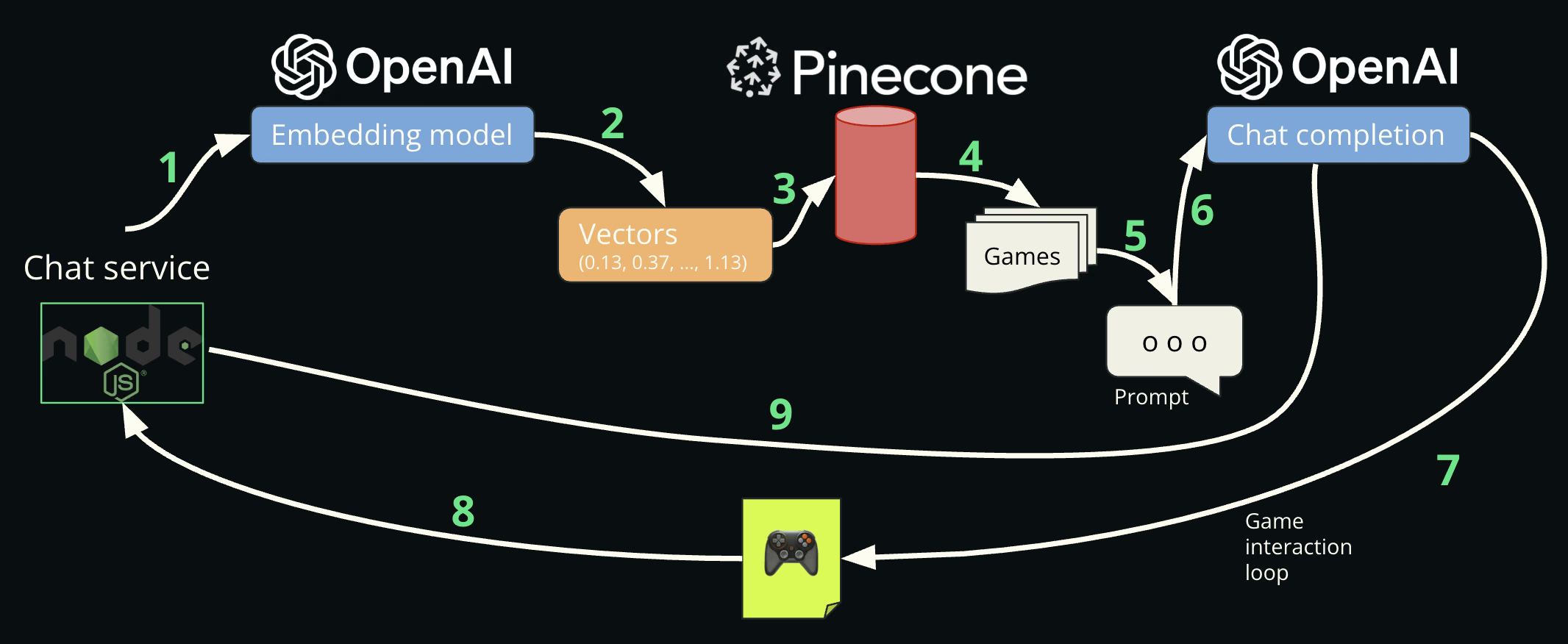
To build reliable autonomous agents, developers must move beyond treating LLMs as black-box APIs. Spec-driven observability embeds telemetry directly into the specification and execution framework of the agent.
Core Dimensions of Agent Observability
- AI Agent Tracing: Full end-to-end visibility into every step of an agent’s reasoning chain, capturing prompt inputs, intermediate thoughts, and final outputs.
- Models Consumed: Tracking latency, performance, and failure rates across varying model tiers (e.g.,
gpt-4.1-nano,gpt-4.1,gpt-4o-turbo). - Tools Called: Instrumentation of external function calls, database lookups, or system scripts executed by the agent, identifying bottlenecks or unexpected loops.
- Token Cost Tracking: Financial telemetry mapping token consumption directly to specific tasks, workflows, and dev teams to keep API spending under control.
- OpenTelemetry for Generative AI: Adopting open standards to standardize semantic conventions for LLM traces, prompts, and tool invocations.
                 LLM EVALUATION & QUALITY FRAMEWORK

 +-------------------+     +-------------------+     +-------------------+
 |       DSPy        |     |     TextGrad      |     |     AdalFlow      |
 |  Declarative LLM  | --> |  Backpropagation  | --> |  Light, Modular   |
 |   Programming.    |     |     via Text.     |     |  LLM Pipelines.   |
 +-------------------+     +-------------------+     +-------------------+
                                     |
                                     v
                  +-------------------------------------+
                  |     CONTINUOUS EVALUATION ENGINE    |
                  |  - Rule-based compliance checks     |
                  |  - Continuous risk evaluation.      |
                  +-------------------------------------+
In compliance with emerging frameworks like the EU AI Act, continuous evaluation libraries (e.g., DSPy, TextGrad, AdalFlow) ensure low-risk and high-risk AI models maintain strict functional accuracy and safety across their operational lifecycle.
Ops Cycle: Incident Response & Smart Alerts
When moving from development to production operations, manual incident management becomes the primary bottleneck.
The 2 PM Deploy Disaster
Consider a typical production incident scenario: At 2:00 PM on a Tuesday, an engineer deploys a new release.
2:00 PM     2:03 PM   2:05 PM    2:10 PM         2:25 PM         2:35 PM     2:38 PM       2:40 PM
 Deploy --+-> Error -> Alert --> Engineer ------> Cause -------> Approval -> Rollback -> Recovered
 Ships    |   Spikes   Fires     Acknowledges     Confirmed      Obtained    Executes
          |
          +---------------------------------------------------------------------------------+
                               40 MINUTES OF DEGRADED SERVICE
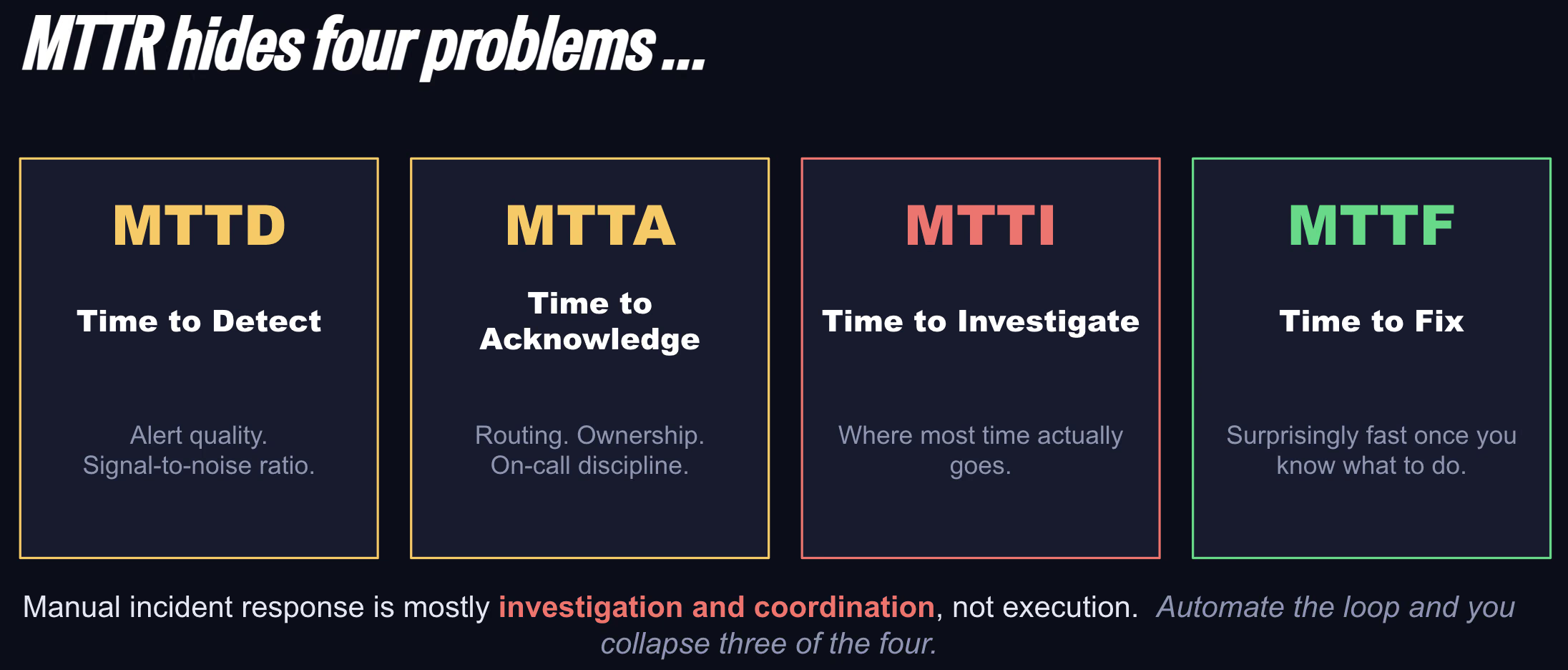
Notice that of the 40 total minutes of degraded service, the actual remediation (rollback) required only 6 minutes. 28 full minutes were consumed by manual investigation, Slack coordination, and approval delays.
The Cost of Outages & MTTR Decomposition
Traditional operations teams spend roughly 33% of engineering time firefighting rather than building features. With the average cost of a production outage reaching $2 million per hour and monitoring platforms processing over 2.2 billion alert events annually, manual coordination is unsustainable.
Smart Alerts: Dynamic Baselines & Anomaly Detection
To collapse MTTD and MTTI, static alert thresholds must be replaced with Machine Learning-driven dynamic baselines.
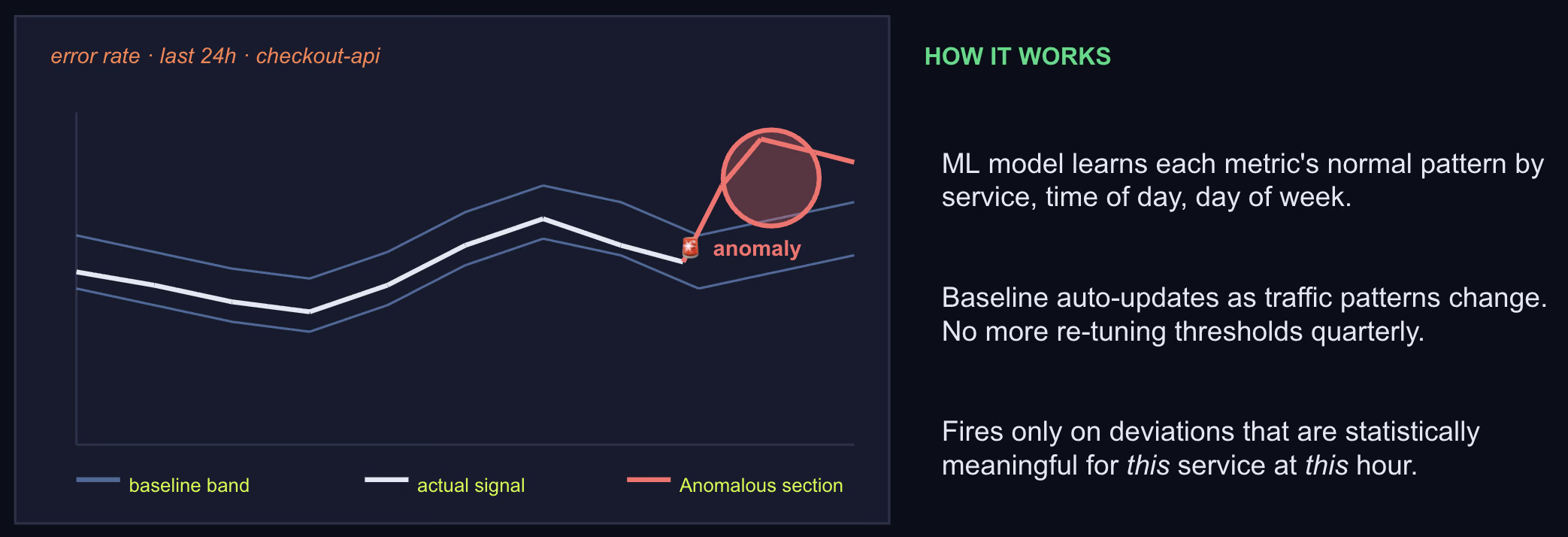
Smart alerts automatically learn metric behavior per service, time of day, and day of week, adjusting baselines continuously and firing only on statistically meaningful anomalies.
Self-Healing Operations Workflow
By integrating agentic AI into observability tools, incident response transitions from manual triage to a 6-stage automated self-healing workflow:
+----------------------------------------------------------------------------+
|                    SELF-HEALING WORKFLOW STAGES                            |
|                                                                            |
|  [01. Alert Trigger] ----------> Smart alert fires in New Relic.           |
|           |                                                                |
|           v                                                                |
|  [02. Root Cause Analysis] ----> SRE Agent performs iRCA across telemetry  |
|           |                      data (logs, traces, metrics).             |
|           v                                                                |
|  [03. Remediation Plan] -------> Agent constructs root cause report and    |
|           |                      and remediation strategy.                 |
|           v                                                                |
|  [04. GitHub Issue] -----------> Automated issue created with full context |
|           |                      and environment stack trace.              |
|           v                                                                |
|  [05. Automated Fix] ----------> GitHub Copilot Agent crafts code fix and  |
|           |                      opens Pull Request.                       |
|           v                                                                |
|  [06. Resolution] -------------> Developer reviews, approves, and merges   |
|                                  PR to restore production.                 |
+----------------------------------------------------------------------------+
- Alert Trigger: A Smart Alert detects an anomalous spike in error rates or latency, initiating an automated workflow execution.
- Root Cause Analysis (iRCA): An autonomous SRE agent investigates telemetry - correlating logs, traces, commit history, and recent deployments to isolate the root cause.
- Remediation Plan: The agent drafts a structured report detailing why the failure occurred and proposing actionable fix steps.
- GitHub Issue Creation: A detailed issue is logged in the code repository, populated with telemetry charts, trace IDs, and diagnostic data.
- Automated Code Fix: A GitHub Copilot Agent generates the required bug fix or config update and opens a target Pull Request.
- Resolution & Merge: The on-call engineer reviews the PR context, validates the automated fix, and merges to trigger deployment recovery.
Sample Walkthrough: From Alert to Automated Pull Request
To ground stages 4 through 6 in a concrete example, here is a real sequence captured from a production repository wired up to New Relic and GitHub Copilot.
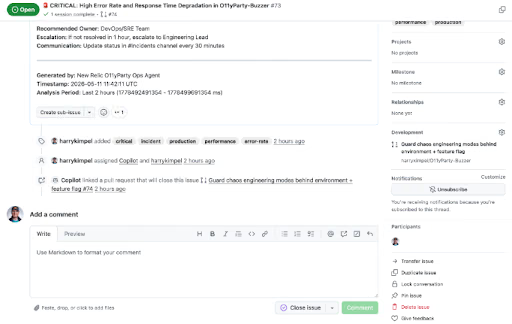
1. GitHub Issue Creation
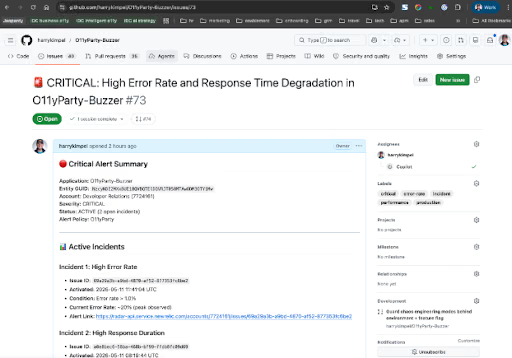
The moment the SRE agent confirms a root cause, it opens a GitHub issue directly against the affected repository. The issue is pre-populated with the critical alert summary, the affected entity, severity, and links back to the active incidents in New Relic - giving the on-call engineer full context without leaving GitHub.
2. Copilot Assignment
Rather than waiting for a human to pick up the issue, the workflow assigns GitHub Copilot as the coding agent. Copilot picks up the labeled issue, analyzes the linked telemetry and stack trace, and gets to work on a fix - visible here as it links a pull request that will close the issue.
3. Automated Pull Request Creation
Copilot opens a pull request implementing the remediation - in this case, guarding a chaos engineering mode behind an environment check and feature flag to stop it from firing in production. The PR includes a description of the root cause and the exact diff, ready for engineer review.
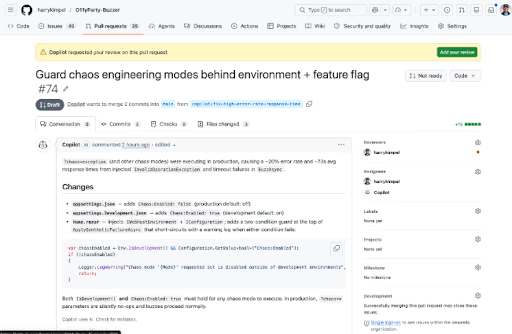
From alert to reviewable pull request, this entire loop runs without a human writing a single line of the initial fix - the engineer’s role shifts from diagnosing and coding to reviewing and approving.
Conclusion & Call to Action
The evolution from traditional DevOps to Agentic AI represents a fundamental paradigm shift in software reliability. By pairing Spec-Driven Observability in development with Self-Healing Operations in production, organizations can eliminate routine operational noise, shrink MTTR from hours to minutes, and enable developers to focus on delivering high-value software.
To successfully adopt agentic workflows in your organization:
- Establish telemetry standards for model token costs, execution latency, and tool invocations early in the dev cycle.
- Transition legacy static alerts to ML-driven dynamic baselines.
- Implement automated SRE agent workflows to collapse investigation times and automate remediation.