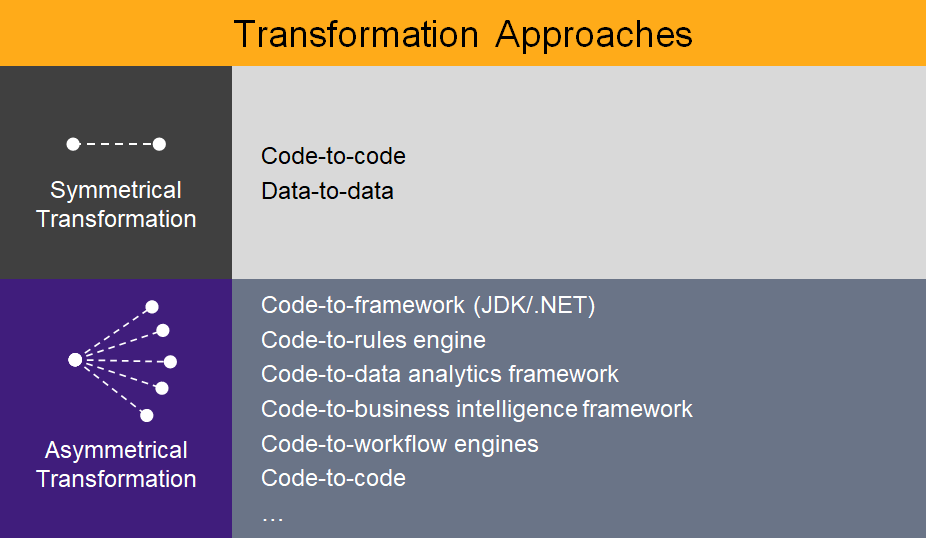
What’s so important about Asymmetrical Transformation?

What’s so important about Asymmetrical Transformation?

As a business technology architect helping clients transform their applications, I sometimes feel more like a software archeologist. It is very interesting to see how heterogeneous the technology landscape is and how diverse it is being used at customers of all size and industry sector. But, there is one common question that we see throughout our engagements: “How can we transform this heritage to a future state?” and “Can you help us keep what’s important, but make it easier to manage?”. ...

January 30, 2017 · 3 min · 442 words · Harry Kimpel

OlivaNova application: performance comparison for H2 Database

A couple of days ago I did some performance tests between Oracle 10g (Express) and Oracle TimesTen. As with any commercial products, there is some licensing and costs involved. Obviously, our idea was then to look for a more cost efficient solution in order to get the same results. We specifically looked at H2, a Java SQL Database. This DBMS can operate in several different modes such as embedded, server and in-memory and has compatibility modes for certain commcercial database products like DB2, MySql, MS SQL Server, Oracle and some others. So, looking at the feature list, this seemed to be a good fit. ...

November 18, 2010 · 2 min · 365 words · Harry Kimpel

Silverlight 4 and WCF RIA Services generated from OlivaNova model

As stated in a recent post, I’ve been able to create a Silverlight 4 client that accesses an OLIVANOVA generated business logic using WCF RIA Services. Well, the actual code to enable this scenario is in fact not that complicated (once you learned how to write Silverlight enabled WCF RIA Services). The big advantage for me is that the complete business logic can be generated with OLIVANOVA’s model driven software development approach. ...

October 21, 2010 · 3 min · 506 words · Harry Kimpel

Did you know that OlivaNova is able to create application information logs automatically?

OLIVANOVA can generate code for application information logs automatically: for .NET environments OLIVANOVA uses the System.Diagnostics.Trace class included in the .NET Framework for J2EE platforms OLIVANOVA uses log4j

October 15, 2010 · 1 min · 28 words · Harry Kimpel

OlivaNova is compatible with TimesTen In-Memory database

I just recently did some evaluation on OLIVANOVA (original URL https://www.care-t.com) along with TimesTen In-Memory Database as the persistence layer. OLIVANOVA is a model driven software development environment that generates code for business software**.** Certified database management systems include all major relational database management systems such as Microsoft SQL Server, Oracle, DB2 and so on. One of OLIVANOVA’s customers required instant responsiveness and very high throughput. So, this was a welcome opportunity for me to evaluate TimesTen, an In-Memory database. I created the model, generated the source code and specified the driver and connection string. In a few minutes I was able to test the application against TimesTen. ...

October 15, 2010 · 1 min · 140 words · Harry Kimpel

Silverlight 4, WCF RIA Services and OlivaNova Business Logic

To me, Silverlight has always been a fascinating technology. I started playing around with Silverlight back in September 2007. Since then, I always wanted to create a Silverlight user interface for OlivaNova. With the first versions, the lack of standard data controls made it really difficult to implement a data-driven application. A lot has changed since then and today the time is ripe to begin afresh. The software architecture basically looks like this: ...

October 13, 2010 · 5 min · 945 words · Harry Kimpel

Audit information specified in a model … part 2

In the first part of this post, I wanted to show how easy it is to access information from the currently logged in user and store this information in an action the user executes (who created/changed a record). Now, what happens, if we have several groups of users (roles)? Well, I could create some IF..ELSE block for each role, but this would probably be not a good idea. A much better approach is to create a base class within the model and inherit all roles from this. So, the model could for instance look like this: ...

October 11, 2010 · 1 min · 174 words · Harry Kimpel

Audit information specified in a model ... part 1

Almost any business application I delivered contains some kind of audit information. Depending on the size and the type of application this information is more or less sufficiently distinctive. Some typical information is almost always “who did what when?”. Sometimes a “why” would also be a justifiable question, but this is out of the scope for now. So, by using a model driven software development approach along with OlivaNova, this is easy. Let’s say, I want to create a new customer in a small CRM system. The class I created for the customer looks like this: ...

October 7, 2010 · 2 min · 268 words · Harry Kimpel

Model Driven Software Development ... a more advanced "Hello World!"

If you want to learn more about model driven software development and how to create your first “Hello World!” example, then please have a look at these tutorials. They explain how to start using the OlivaNova Modeler. All tutorials are available here: https://www.care-t.com/Evaluation/index.asp?menu=2

October 7, 2010 · 1 min · 43 words · Harry Kimpel

XMI to XMI converter

While playing around with some XMI (XML Metadata Interchange) importing/exporting functionality, I found this great blog: Modeling LAnguages (original URL https://modeling-languages.com). His service to convert from one XMI format to another is just awesome. Have a look at this site: XMI2 - A tool for exchanging UML models among CASE tools (original URL https://modeling-languages.com/content/xmi2-tool-exchanging-uml-models-among-case-tools).

August 5, 2010 · 1 min · 54 words · Harry Kimpel