Fun Project: Amazon Alexa Skill for New Relic Insights

Fun Project: Amazon Alexa Skill for New Relic Insights

As a fun project in some spare time, I recently worked on a way to tell Amazon Alexa how to talk to New Relic Insights and retrieve some high-level information about an account. I was just curious on what it would take to get Alexa to access our Insights API with a voice command and Alexa to speak out some result of this query. You typically start by creating an Amazon developer account and register a new Alexa Skill with the Alexa Skills Kit. ...
November 3, 2017 · 5 min · 855 words · Harry Kimpel
APM with Microsoft .NET Core on Azure

APM with Microsoft .NET Core on Azure

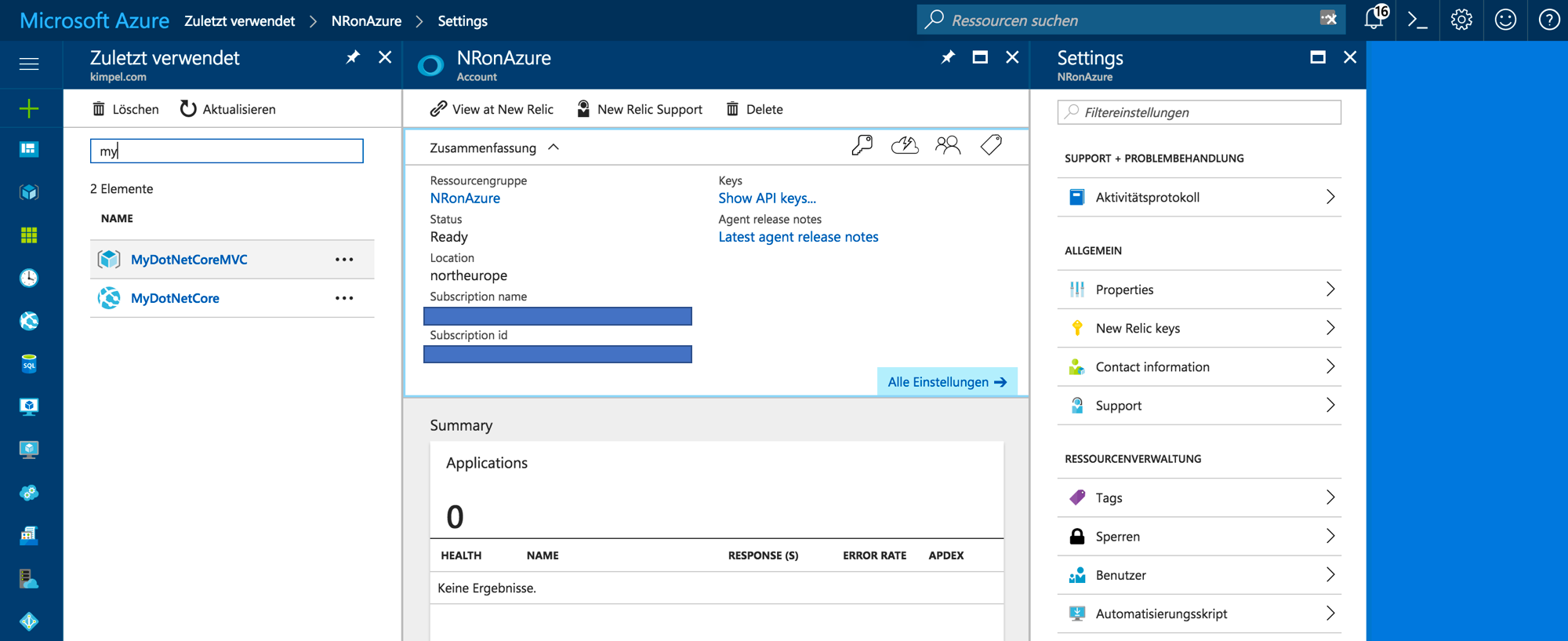
One of the things I am very interested in is the .NET stack and especially the .NET Core platform. In this blog post I want to briefly highlight what it takes to get a sample .NET Core application up and running on Azure and how to use New Relic’s Application Performance Monitoring (APM) to monitor this application. Please note: while I am writing this, the latest version of .NET Core SDK is .NET Core 2.0 Preview 2; dependent upon how you get the SDK, there is already a preview 3 of the .NET Core CLI out there, but this is currently not supported on Azure. You can check for support by using a Developer Console (Developer Tools –> Console of an Azure App Service) within the Azure portal and navigate to D:\Program Files (x86)\dotnet\sdk. ...

September 20, 2017 · 3 min · 577 words · Harry Kimpel
New Relic's APM demo on IBM BlueMix

New Relic's APM demo on IBM BlueMix

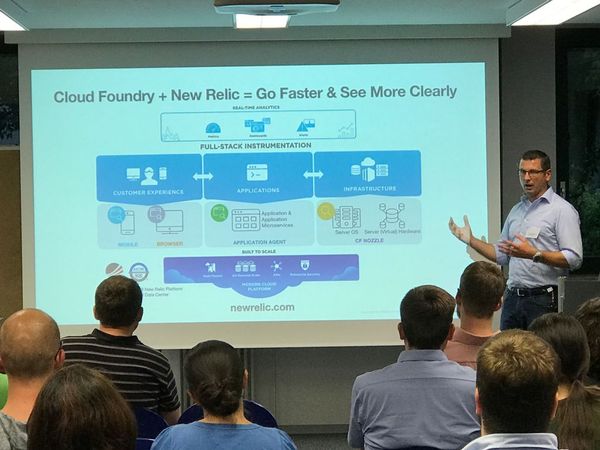
Last week, we had the chance to present at a local Cloud Foundry Meetup in Stuttgart/Germany and the key topic was around IBM BlueMix (BM). My idea was to show and demo something around New Relic and BM. Due to my ignorance, I actually did not know that IBM BM is also based upon the open source platform Cloud Foundry (CF). Interestingly enough, I was involved in quite some CF engagements in my previous life and so I knew what it would take to get a so-called Spring-Boot type application (https://projects.spring.io/spring-boot/) up and running on this platform. It basically follows the same pattern of using the CF-CLI (Command Line Interface) to deploy an app. ...

August 7, 2017 · 3 min · 429 words · Harry Kimpel
Azure Mobile Center ... and the art of debugging :-)

Azure Mobile Center ... and the art of debugging :-)

As a side project, I recently worked on creating a mobile app for Android (and iOS to be completed). To be honest, the development effort was quite straight forward. The development stack focused on Xamarin, because I do not know a thing about creating a native app for Android nor iOS. But, I do know C# … so, for me this was a natural choice :-) My knowledge in the area of Xamarin was quite limited and I did not create an app for Android or iOS before. However, the path from idea to prototyping was really smooth. There are a ton of kickstart packages out there and the documentation is amazing. You’ll find tons of articles, knowledge base and other posts that are really helpful. ...

March 30, 2017 · 3 min · 631 words · Harry Kimpel
What the heck is a parser-combinator?

What the heck is a parser-combinator?

Background and Basics In a recent project engagement, we were assigned the job to migrate a COBOL-based mainframe application to a new environment. The core theme specifically for this project follows a re-hosting approach. The reasoning for this type of approach is agreed upon with the customer mainly due to time and cost. Of course, the scope and effort for such a transformation is quite huge and there are many tasks involved for the complete application to run on a completely different platform. Some of the activities include: ...

February 28, 2017 · 9 min · 1816 words · Harry Kimpel
Re-architect applications for the cloud

Re-architect applications for the cloud

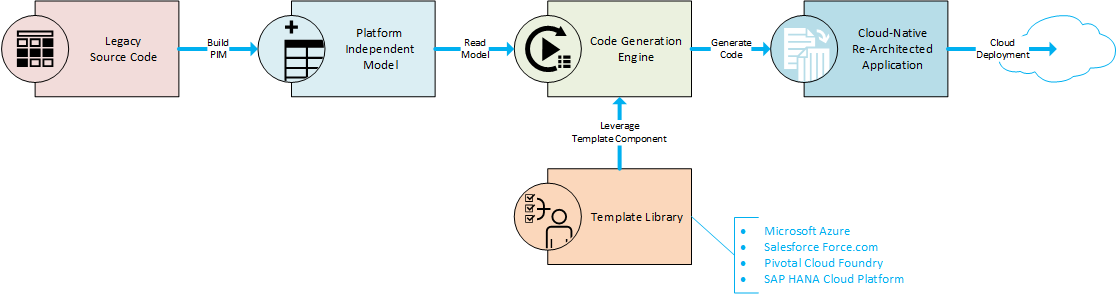
The path towards cloud-native applications is being adopted by more and more companies. For green-field applications this is a natural choice to architect your applications in a way so that they can be developed, deployed and operated in a cloud environment. This of course could mean on-prem, hybrid or public cloud. When thinking about your heritage applications and your desire to modernize those, a cloud migration isn’t typically an easy thing to do. Not primarily because of technical reasons, but typically because they exist for a reason and in many cases these applications are mission-critical. Once you made a transformation decision and you created a business case, the next step is to come up with a suitable roadmap for the application. In a previous post, I described the major approaches of such a transformation. In my opinion there is only one suitable way if you truly want to leverage cloud-native concepts and make use of benefits from a cloud deployment … and that is a re-architecture. ...

February 7, 2017 · 3 min · 617 words · Harry Kimpel
What’s so important about Asymmetrical Transformation?

What’s so important about Asymmetrical Transformation?

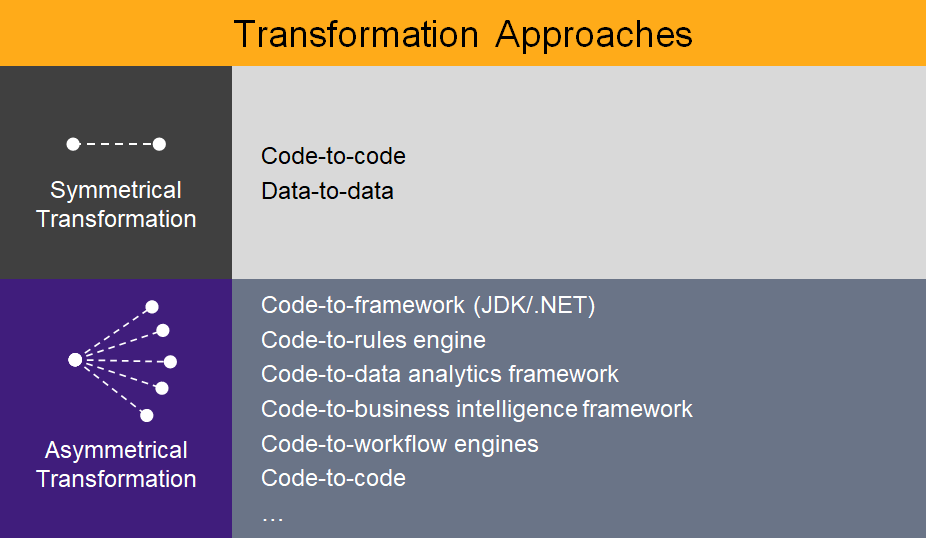
As a business technology architect helping clients transform their applications, I sometimes feel more like a software archeologist. It is very interesting to see how heterogeneous the technology landscape is and how diverse it is being used at customers of all size and industry sector. But, there is one common question that we see throughout our engagements: “How can we transform this heritage to a future state?” and “Can you help us keep what’s important, but make it easier to manage?”. ...

January 30, 2017 · 3 min · 442 words · Harry Kimpel

SAP HANA Cloud Platform – custom application deployment ... lessons learned

As I have mentioned in a previous post, I finally managed to deploy and run a custom application in SAP HANA Cloud Platform (HCP). The difficult part for me was not setting up the environment per se, but to solve all the source dependencies and unknowns around the platform’s prerequisites. I found it really challenging to actually find the relevant information on the web, so I decided to write this post to list a set of issues I ran into and how I managed to solve them. Some of the items might not be surprising and for some these will be self-evident, but at least for me these were Aha! moments. I have to add that I am not a real Java expert (I am much more familiar with the Microsoft development ecosystem), so please ignore my ignorance around this technology stack. ...

December 23, 2016 · 4 min · 743 words · Harry Kimpel
SAP HANA Cloud Platform - custom application deployment

SAP HANA Cloud Platform - custom application deployment

I am very excited that I managed to deploy and execute my first application on SAP HANA Cloud Platform (https://hcp.sap.com/ (original URL https://hcp.sap.com/)) today. It uses the native in-memory database and application services. The base application source code was generated using Ciber Momentum Engineer (https://momentum.ciber.com/) and then customized to fit their platform-as-a-service environment. I have to admit that this was not quite straight forward and I had to go through a significant amount of trial & error before I finally managed to deploy the application itself without any issues and exceptions being thrown. It also took quite a while until the database automatically got populated with all the business entities or rather tables. There are quite a lot of dependencies and restrictions that you have to know and be aware of; i.e. things like ...

December 21, 2016 · 1 min · 202 words · Harry Kimpel

The next break-down is about to happen (soon)

Banking Briefing I just recently did a talk on application modernization for attendees from the financial services industry. The discussions we had afterwards were quite interesting and I enjoyed the sharing of ideas and potential solutions. Interestingly enough, on my flight back home, I read an article in one of the biggest German newspapers. The title of this article was (more or less) “The next break-down is about to happen soon”. The content basically is all about digital transformation in the banking industry and how constantly evolving customer demand and expectation is the reason why these huge financial institutions are struggling to cope with these requirements. The root cause seems to be too many and over-aged applications in their IT landscape. The article mentions that an average (German) bank has about 1,200 (!) IT applications deployed and in production. ...

July 27, 2016 · 2 min · 254 words · Harry Kimpel