Optimizing Kafka Tracing with OpenTelemetry: Boost Visibility & Performance

Optimizing Kafka Tracing with OpenTelemetry: Boost Visibility & Performance

Ideally, you should be using distributed tracing to trace requests through your system, but Kafka decouples producers and consumers, which means there are no direct transactions to trace between them. Kafka also uses asynchronous processes, which have implicit, not explicit, dependencies. That makes it challenging to understand how your microservices are working together. However, it is possible to monitor your Kafka clusters with distributed tracing and OpenTelemetry. You can then analyze and visualize your traces in an open-source distributed tracing tool like Jaeger or a full observability platform like New Relic. In this post, I will leverage a simple application to show how you can achieve this. ...

July 4, 2025 · 6 min · 1275 words · Harry Kimpel
How To Observe Your Blazor WebAssembly Application With OpenTelemetry And Real User Monitoring

How To Observe Your Blazor WebAssembly Application With OpenTelemetry And Real User Monitoring

Effortless integration and enhanced visibility with OpenTelemetry in Blazor WebAssembly Challenges in observing WebAssembly applications Observing WebAssembly applications presents unique challenges that stem from its design and execution environment. Unlike traditional web applications, where monitoring tools can hook directly into JavaScript and the Document Object Model (DOM), WebAssembly runs as binary code executed within the browser’s sandbox. This layer of abstraction complicates direct introspection, as traditional monitoring tools are not designed to interact with the lower-level operations of WebAssembly. The Bytecode Alliance plays a crucial role here, promoting standards and tools that aim to enhance the security and usability of WebAssembly, including better support for observability. Moreover, the performance characteristics of WebAssembly, which can closely approach native speeds, demand monitoring solutions that are both highly efficient and minimally invasive to avoid impacting the user experience. This creates a complex scenario for developers who need detailed visibility into their applications’ behavior without sacrificing performance. ...

May 16, 2024 · 10 min · 2056 words · Harry Kimpel
Forward Snyk Vulnerability data to Splunk Observability Cloud

Forward Snyk Vulnerability data to Splunk Observability Cloud

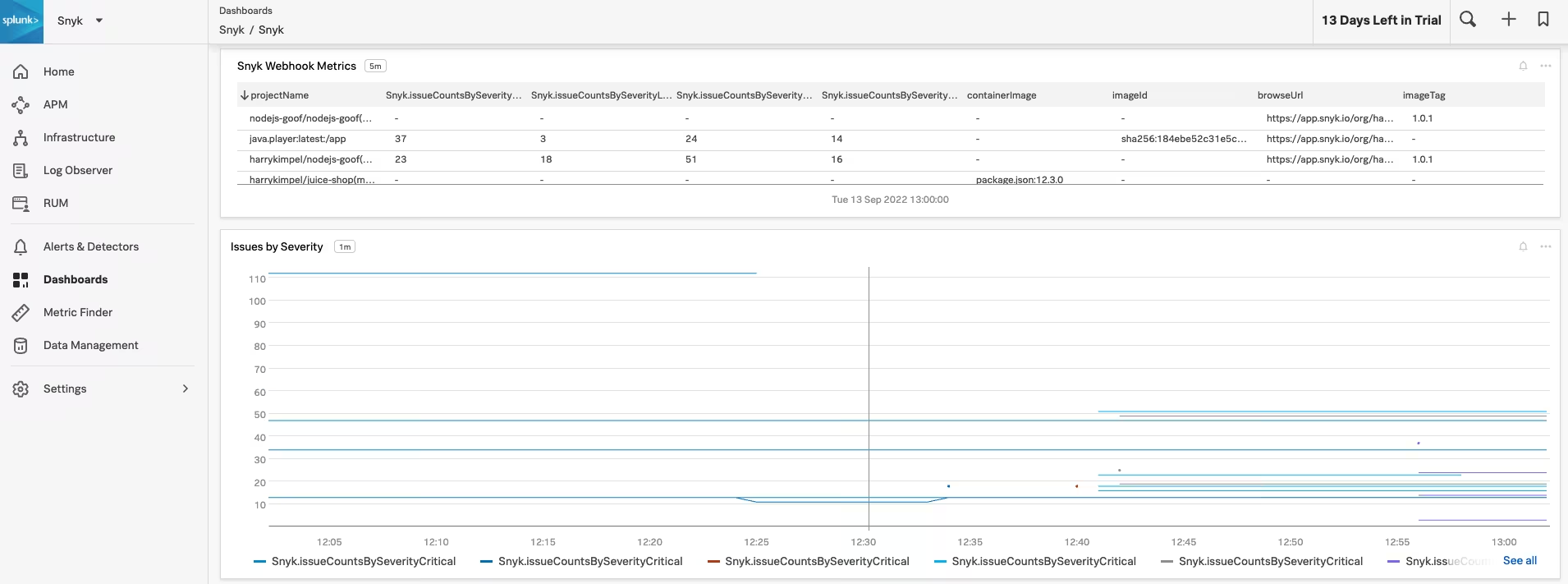
TL;DR Leverage a Prometheus Exporter to send all your application security vulnerabilities from Snyk into Splunk. Here are all the necessary links to get started: Snyk Exporter: https://github.com/lunarway/snyk_exporter Splunk OpenTelemetry Collector for Kubernetes: https://docs.splunk.com/Observability/gdi/opentelemetry/install-k8s.html#otel-install-k8s Update (2022-09-22) The option that I am describing here is just one way to achieve this. There might even be a more straight forward option available that I started to describe in a more recent post. Please find an additional approach in my post Snyk Integration Capabilities with WebHooks - some examples. ...

September 13, 2022 · 3 min · 505 words · Harry Kimpel
How-To: Set-up New Relic to observe Dapr and it's applications

How-To: Set-up New Relic to observe Dapr and it's applications

How-To: Set-up New Relic to collect and observe metrics, traces and logs from Dapr and the underlying applications. Enable Dapr metrics and logs with New Relic Kubernetes integration for Azure Kubernetes Service (AKS) and application traces using OpenTelemetry. Prerequisites Azure Kubernetes Service kubectl An installation of Dapr on Kubernetes Perpetually free New Relic account, 100 GB/month of free data ingest, 1 free full access user, unlimited free basic users Enable New Relic Kubernetes integration The Kubernetes integration monitors worker nodes. In Azure Kubernetes Service, master nodes are managed by Azure and abstracted from the Kubernetes platforms. ...

November 21, 2020 · 8 min · 1533 words · Harry Kimpel